In-Home vs. Center-Based Childcare US 2025: Costs & Benefits Analysis

Choosing between in-home and center-based childcare in the US for 2025 involves weighing significant data-driven factors concerning costs, developmental benefits, and logistical considerations to best suit a family’s unique needs and priorities.
For parents in the United States, selecting the right childcare option is one of the most significant decisions they will make, impacting both their child’s development and the family’s financial well-being. This article delves into a comprehensive analysis of comparing in-home vs. center-based childcare in the United States for 2025: a data-driven analysis of costs and benefits, offering insights grounded in current trends and expert projections. Understanding the nuances of each option is crucial for making an informed choice that aligns with your family’s unique needs and values.
Understanding In-Home Childcare: Personalization and Flexibility
In-home childcare, often provided by nannies, au pairs, or family members, offers a highly personalized environment for a child’s development. This option typically means care occurs within the child’s own home, providing a familiar setting that many parents find comforting. The primary appeal lies in the individualized attention a child receives, fostering a strong bond with a single caregiver.
The flexibility inherent in in-home care is a major draw for families with non-traditional work schedules or those who prefer their children to remain in a home setting. Caregivers can often adapt to specific family routines, dietary preferences, and educational philosophies more readily than a larger institution. This bespoke approach can be particularly beneficial for infants and toddlers who thrive on consistent routines and a calm environment.
Types of In-Home Childcare Providers
- Nannies: Professional caregivers employed directly by the family, offering dedicated care, often with specialized skills or training.
- Au Pairs: Cultural exchange participants who provide childcare in exchange for room, board, and a cultural experience, typically offering a more affordable live-in option.
- Family Child Care Homes: Small, licensed operations run out of a caregiver’s home, often caring for a small group of children of varying ages.
Despite the benefits of personalized care and flexibility, parents must consider the potential for social isolation for the child and the responsibility of managing a caregiver’s employment. Thorough vetting, clear contracts, and ongoing communication are vital for a successful in-home childcare arrangement. Ultimately, the decision often hinges on a family’s specific needs for flexibility, their budget, and their desire for a highly customized care experience.
Exploring Center-Based Childcare: Structure and Socialization
Center-based childcare, encompassing daycare centers, preschools, and educational programs, provides a structured environment designed for group learning and social development. These facilities operate under specific licenses and regulations, often adhering to curricula that support cognitive, emotional, and physical growth. The setting is typically dynamic, with multiple caregivers and a diverse group of children.
A significant advantage of center-based care is the emphasis on early education and socialization. Children learn to interact with peers, share, and follow routines, skills that are foundational for school readiness. Many centers employ staff with degrees in early childhood education, bringing a professional and pedagogical approach to childcare. The structured environment often includes a variety of age-appropriate activities, toys, and learning materials.
Key Benefits of Center-Based Programs
- Structured Curriculum: Often follow educational frameworks that promote learning and development.
- Social Interaction: Provides ample opportunities for children to play and learn with peers, fostering social skills.
- Professional Staff: Caregivers typically have formal training in early childhood education and development.
- Reliability: Centers usually have backup staff, ensuring consistent care even if a primary caregiver is absent.
While offering numerous developmental advantages, center-based childcare can be less flexible with schedules and may have higher child-to-staff ratios. Parents should investigate accreditation, staff turnover rates, and the center’s philosophy to ensure it aligns with their expectations. The communal nature of these settings also means children may be exposed to more illnesses, a common concern for many families. However, for those prioritizing structured learning and social development, center-based options remain a popular and effective choice.
Cost Analysis for 2025: In-Home vs. Center-Based Childcare
The financial implications of childcare are often a primary concern for families. In 2025, the cost landscape for both in-home and center-based childcare continues to evolve, influenced by inflation, labor shortages, and regional variations. Understanding these costs is crucial for budget planning and making an economically sound decision.
In-home childcare, while offering personalization, can often be more expensive on an hourly or weekly basis, especially for a single child. Families are responsible for a caregiver’s salary, benefits (if applicable), and potentially taxes. However, for families with multiple children, the per-child cost of a nanny can sometimes be comparable to, or even less than, enrolling each child in a center. The cost can also vary significantly based on the caregiver’s experience, location, and the specific duties required.
Average Weekly Costs (Projected for 2025)
- Nanny/Au Pair: $700 – $1500+ per week (highly dependent on location, hours, and experience).
- Family Child Care Home: $250 – $450 per week.
- Center-Based Care: $200 – $500 per week per child (varies by age, location, and program quality).
Center-based childcare typically presents a more predictable cost structure, often charged weekly or monthly per child. While seemingly lower per child than a nanny, these costs can quickly accumulate for families with multiple children. It is also important to factor in additional fees for enrollment, activities, or extended hours, which can add up. Government subsidies and employer benefits can significantly offset these costs, making it essential for families to research available assistance programs. Ultimately, a detailed financial comparison, factoring in all potential expenses and subsidies, is necessary to determine the most affordable and suitable option for each family.
Developmental Outcomes: What the Data Shows
Beyond costs, parents are keenly interested in how different childcare settings impact their child’s developmental outcomes. Research consistently highlights various benefits associated with both in-home and center-based care, suggesting that quality of care is often more impactful than the setting itself. However, each environment tends to foster different strengths.
In-home childcare often excels in providing a secure attachment and individualized learning pace. Children in these settings may develop stronger bonds with their primary caregiver, which can contribute to emotional security and self-confidence. The one-on-one attention can also be beneficial for children with specific learning needs or those who thrive in a quieter, more controlled environment, allowing for tailored activities and focused instruction.
Impact on Key Developmental Areas
- Social-Emotional Development: Center-based care often promotes earlier and more frequent interaction with peers, enhancing social skills and conflict resolution. In-home care can foster deeper emotional bonds with a primary caregiver.
- Cognitive Development: Both settings can support cognitive growth. Centers often have structured curricula, while in-home care allows for highly personalized educational activities.
- Language Development: Exposure to varied vocabulary and conversations in both settings is beneficial, with centers potentially offering a wider range of linguistic interactions.
Center-based care, with its emphasis on group activities and structured learning, often provides a rich environment for social and pre-academic skill development. Children learn to navigate group dynamics, share resources, and follow classroom rules, preparing them for formal schooling. The presence of multiple caregivers and diverse peer groups also exposes children to different personalities and perspectives. The optimal developmental outcome, therefore, often depends on matching the child’s temperament and needs with the strengths of the chosen childcare environment, coupled with high-quality interactions regardless of the setting.
Logistical Considerations and Parental Support
The practicalities of daily life heavily influence childcare decisions. Logistical factors, including convenience, hours of operation, and geographic location, play a significant role in determining the most viable option for busy families. Additionally, the level of parental support and peace of mind each option offers is a critical, albeit often overlooked, benefit.
In-home childcare typically offers unparalleled convenience. There’s no daily commute to a childcare facility, which saves time and reduces stress for parents. This can be particularly advantageous for families with multiple children or those living in areas with limited public transportation. The flexibility in scheduling can also accommodate unpredictable work hours or last-minute changes, offering a sense of control and adaptability that center-based options often cannot match.
Key Logistical Factors
- Commute: In-home care eliminates the daily drop-off/pick-up, while center-based care requires consistent transportation.
- Hours of Operation: Centers have fixed hours, whereas in-home care can often be more flexible, adapting to parents’ schedules.
- Sick Child Care: In-home caregivers may be more willing to care for mildly ill children, a service centers typically cannot provide due to health policies.
Center-based childcare, while requiring daily drop-offs and pick-ups, offers a predictable routine and a clear separation between home and work life for parents. Many centers are conveniently located near workplaces or major commuter routes. The peace of mind for parents often comes from knowing their child is in a regulated environment with multiple adults present and a structured emergency plan. Ultimately, the best choice hinges on a family’s daily routine, work demands, and their prioritization of convenience versus structured institutional care.
Regulatory Landscape and Quality Assurance in 2025
Ensuring the safety and quality of childcare is paramount for all parents. The regulatory landscape for childcare in the United States is complex, with varying standards at federal, state, and local levels. Understanding these regulations and quality assurance measures is essential when evaluating both in-home and center-based options for 2025.
Center-based childcare facilities are generally subject to more stringent licensing and oversight. States typically mandate specific ratios of caregivers to children, staff qualifications, health and safety standards, and curriculum requirements. Regular inspections help ensure compliance, providing a layer of public accountability and transparency for parents. Accreditation by national organizations, though voluntary, further signifies a commitment to high-quality standards, often exceeding basic licensing requirements.
Ensuring Quality and Safety
- Center Licensing: State-mandated regulations covering health, safety, and staff qualifications.
- Accreditation: Voluntary programs (e.g., NAEYC) that signify higher quality standards and best practices.
- In-Home Vetting: Requires parents to conduct thorough background checks, reference checks, and interviews.
For in-home childcare, the regulatory framework is often less comprehensive. While some states require family child care homes to be licensed, individual nannies or au pairs typically are not. This places a greater responsibility on parents to conduct their due diligence, including extensive background checks, verifying references, and establishing clear employment contracts. Trust and open communication with the caregiver become even more critical in these arrangements. Regardless of the setting, proactive research into licensing, accreditation, and a provider’s history is crucial for safeguarding a child’s well-being and ensuring a high-quality care experience.
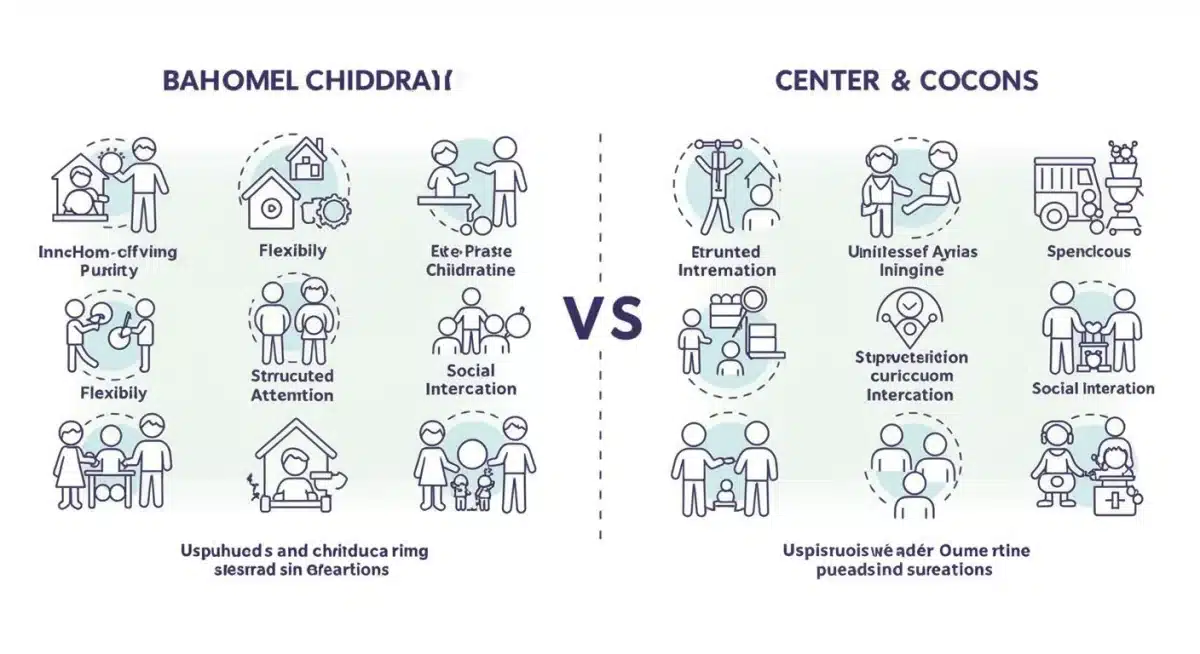
| Key Aspect | In-Home Childcare | Center-Based Childcare |
|---|---|---|
| Cost (2025 Avg.) | Often higher per child, but less for multiple children; variable. | Predictable per child cost; increases with multiple children. |
| Flexibility | High customization for schedules, routines, and specific needs. | Fixed hours and routines; less adaptable to individual changes. |
| Socialization | Limited peer interaction; strong caregiver bond. | Extensive peer interaction, group learning, and social skill development. |
| Regulation & Oversight | Less formal; relies heavily on parental vetting and trust. | Strict state licensing, regular inspections, and potential accreditation. |
Frequently Asked Questions About Childcare Options
▼
Not necessarily. While a nanny for one child might be pricier, families with multiple children often find in-home care to be more cost-effective than enrolling each child in a separate center-based program. Location and caregiver experience also significantly influence the cost.
▼
Thorough vetting is crucial. Conduct comprehensive background checks, verify references extensively, interview candidates multiple times, and establish a clear contract outlining responsibilities, expectations, and compensation. Trust and open communication are foundational.
▼
Yes, it is common for children in group settings to experience more frequent illnesses initially. This exposure helps build their immune system over time, but parents should be prepared for more sick days, especially during the first year of attendance.
▼
Center-based care excels in fostering social skills, peer interaction, and early academic readiness through structured curricula and group activities. Children learn sharing, cooperation, and following routines, which are vital for school success.
▼
Many families are eligible for financial assistance, including state-funded childcare subsidies, federal tax credits (like the Child and Dependent Care Credit), and employer-sponsored benefits. Researching local and federal programs is highly recommended to explore available support.
Conclusion
The decision between in-home and center-based childcare in the United States for 2025 is deeply personal, influenced by a complex interplay of financial realities, developmental priorities, and logistical needs. While in-home care offers unparalleled flexibility and individualized attention, center-based options provide structured learning and vital socialization opportunities. Both settings, when of high quality, can foster positive outcomes for children. Families are encouraged to thoroughly research costs, understand the regulatory frameworks, and consider their child’s temperament and their own lifestyle. Ultimately, the best choice is the one that provides a safe, nurturing, and enriching environment that aligns perfectly with the unique dynamics of their family, ensuring peace of mind and optimal development for their child.